

144,284.00
+1,155.006,588.13
-71.8715.35
+0.48Resilient local communities are fundamental to our licence to operate and to our long-term value creation.
We define these communities as places where people, institutions, infrastructure and ecosystems are collectively able to withstand, adapt to, and recover from shocks and long-term stresses, while continuing to provide essential services, maintain social and economic functioning, and improve wellbeing over time.
We have strong priority intervention areas, long-term outcomes and impact pathways in place to support our communities. At present, we’re focusing our efforts on delivering the interventions that will make a material difference to their lives.
Poor health outcomes and social harm (e.g., GBV) undermine community wellbeing and workforce participation.
Invest in targeted health, wellbeing, and social support interventions with a clear focus on prevention.
Strengthen healthy communities that can participate fully in social and economic life.
High reliance on public health systems; sensitive social issues
Gaps in essential services undermine quality of life, economic participation & social stability.
Unlock infrastructure that enables reliable access to essential services in communities.
Support functional, reliable basic services that enable communities to thrive independently over time.
High regulatory prescription through SLPs, reliance on municipal capability.
Weak education progression and pathways into work are a core driver of dependency & unemployment.
Invest in targeted interventions that improve learning outcomes & convert into relevant opportunities.
Enable access that translates into sustainable employment & income opportunities.
Highly interdependent with public education systems, must align with SLP HRD commitments.
Local economies are constrained by capability gaps and overly dependent on mining-linked activity.
Catalyse SED1 & LED and ensure participation through providing local livelihood opportunities.
Build capable local livelihoods, suppliers and employers to build a thriving local economy.
BBBEE requirements shape focus; interventions must avoid single- buyer dependency on Valterra.
Poor health outcomes and social harm (e.g., GBV) undermine community wellbeing and workforce participation.
Invest in targeted health, wellbeing, and social support interventions with a clear focus on prevention.
Strengthen healthy communities that can participate fully in social and economic life.
High reliance on public health systems; sensitive social issues
Gaps in essential services undermine quality of life, economic participation & social stability.
Unlock infrastructure that enables reliable access to essential services in communities.
Support functional, reliable basic services that enable communities to thrive independently over time.
High regulatory prescription through SLPs, reliance on municipal capability.
Weak education progression and pathways into work are a core driver of dependency & unemployment.
Invest in targeted interventions that improve learning outcomes & convert into relevant opportunities.
Enable access that translates into sustainable employment & income opportunities.
Highly interdependent with public education systems, must align with SLP HRD commitments.
Local economies are constrained by capability gaps and overly dependent on mining-linked activity.
Catalyse SED1 & LED and ensure participation through providing local livelihood opportunities.
Build capable local livelihoods, suppliers and employers to build a thriving local economy.
BBBEE requirements shape focus; interventions must avoid single- buyer dependency on Valterra.
We are currently invested in the following key initiatives:
Across the Mototolo and Twickenham communities, learners receive eye screenings and spectacles through the Framing the Future initiative.
Delivered with our partners, the programme has improved the sight of hundreds of learners, and so boosted their confidence in the classroom.
Our Mototolo mine recently handed over the Mmahlagare ECD Centre, which provides modern learning facilities for the community’s youngest learners.
The facility includes classrooms, accessible sanitation, a kitchen, sick bay and water storage, all built for long-term use. The project also created local jobs and benefitted 32 local SMMEs.
At Sengange and Madiete Secondary Schools, also near Mototolo mine, limited digital resources and unreliable water access were disrupting daily learning and administration.
Together with our partners, Mapudi Investments, Tutuka Joint Venture and Red Metal Mining, we provided laptops, a copier, IT accessories and software subscriptions, as well as water tanks, taps and a reservoir to stabilise school operations.
Across the Tubatse region, we support partners working to strengthen community-based responses to gender-based violence.
Through training, mentorship and operational support, local victim support centres are better equipped to care for survivors and sustain their services.
We recognise that lasting impact comes from empowering communities to protect and support one another.
At Groenfontein Farm near Mokopane, we are developing a commercially sustainable agricultural hub focused on vegetable production, oil processing for cosmetics use and skills development.
Through initiatives such as the Kalahari melon seed project, the farm supported 18 local jobs in 2025, with 66% women and 53% youth, while serving as a practical training and incubation platform for emerging farmers.
Through employment, skills transfer and local production, the project helps build sustainable livelihoods and stimulate long-term economic activity.
We recently delivered solar-powered water systems to the Mogoleng and Potlako communities near Mototolo mine, enabling clean, reliable running water.
The project includes boreholes, solar-powered pumps, water tanks, communal points and village-wide piping, all designed for durability and long-term use.
Delivered with Innovation Africa, local government and traditional authorities, the systems are community managed, remotely monitored, and supported through local training and employment.
The mining sector’s Social and Labour Plans (SLP) are dynamic and strategic interdisciplinary planning frameworks that aim to promote employment, human resources development, and the social and economic upliftment of employees and mine communities.
They are also working documents that manage the planning, strategic development and implementation of these commitments.
Mining and production businesses commit to their SLPs at the beginning of every five-year cycle for the duration of the life of each mine.
SLPs are used to achieve sustainable socio-economic development, empowerment and transformation.
The third cycle of SLPs for Valterra Platinum mining operations covers the duration 2021 to 2025. The fourth Social and Labor Plans, which are now available, will cover the period 2026 – 2030.
Social & labour plan update slp 3 2021 - 2025
Valterra Platinum
Installation of solar streetlights
Resealing of 6 streets in Mokopane
Water provision to Mogalakwena communities
Whole school development programme
Community oriented primary care
Construction of early childhood development centre in Nokaneng
Reconstruction of Viljoen Street (Lydenburg Town)
Water provision
Whole school development programme
Support improving health in schools (Thaba Chweu and Fetakgomo Tubatse local municipalities)
Water provision
Paving of internal roads in Mantserre
Whole school development programme
Community oriented primary care
Community training Twickenham SLP 3 approved Q4 2024 project implementation in progress for other infrastructure
Our community equity scheme
In 2011, Valterra Platinum established a community equity transaction called Alchemy as a long-term mechanism to drive sustainable development and meaningful transformation in the communities that host our operations. The transaction was structured to provide equity ownership through development trusts (DTs) and a non-profit company (NPC). The Lefa La Rona Trust (LLRT) was set up as the umbrella trust through which the DTs and NPC hold their interest in Valterra Platinum.
LLRT distributes funds proportionally to each of the DTs and NPC for the beneficiary communities based on their participation interest. (This was determined in accordance with the anticipated resources and reserves usage of each mine over a 30-year period, as estimated on 31 December 2010).
Registered 2012
Participation interest
Registered 2013
Participation interest
Registered 2014
Participation interest
Registered 2015
Participation interest
Registered 2016
Participation interest
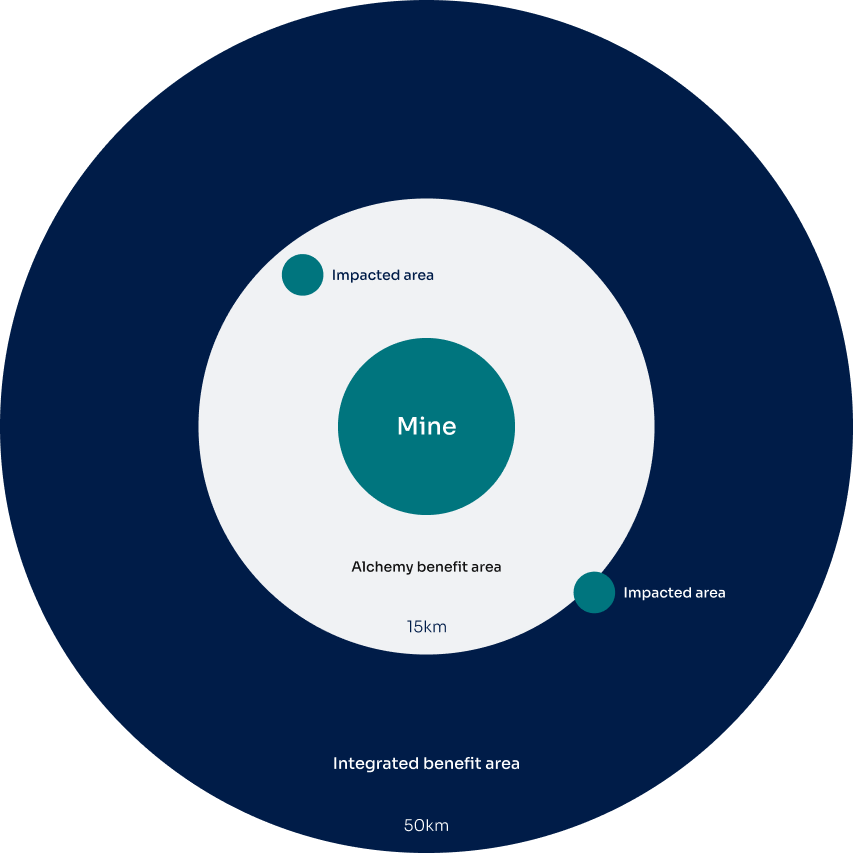
The development trusts benefit communities within 15km of an eligible operation.
The Dikuno Tsa Sechaba Trust serves Amandelbult and its surrounds, the Rustenburg Community Development Trust serves Rustenburg’s operations and its surrounds, the Bohwa Bja Rena Development Trust serves Twickenham and its surrounds, and the Ditholwana T’sa Rena Trust serves Mogalakwena and its surrounds. The development trusts also flow benefits within the integrated benefit communities, which extend to a 50km radius.
The development trusts benefit communities within 15km of an eligible operation.
The Dikuno Tsa Sechaba Trust serves Amandelbult and its surrounds, the Rustenburg Community Development Trust serves Rustenburg’s operations and its surrounds, the Bohwa Bja Rena Development Trust serves Twickenham and its surrounds, and the Ditholwana T’sa Rena Trust serves Mogalakwena and its surrounds.
The development trusts also flow benefits within the integrated benefit communities, which extend to a 50km radius.
Integrated benefits (including Corporate Social Investment and Social Labour Plan initiatives) are deployed within 50km of the operations.
Broader integrated planning is deployed to ensure that Alchemy and other development initiatives are complementary.
The trusts were designed in consultation with local working groups who are familiar with community dynamics and their development requirements.
The operating model also places a strong emphasis on collaboration and strategic partnerships, recognising them as essential drivers for unlocking transformative and sustainable development.
The trusts and NPC have administrators who are responsible for the day-to-day management of their operations. These administrators are appointed by trustees or directors after the respective boards are satisfied that the proposed appointee has the skills, experience and qualifications to properly discharge their duties.
The development trusts have a responsibility to hold annual general meetings to report critical matters and to provide beneficiaries with the opportunity to have their voices heard.
To date, over R830 million has been invested in targeted socio-economic development initiatives aimed at improving access to education, healthcare, digital inclusion and sustainable livelihoods.
Dividends and other sources of funding received to date have amounted to R1.4 billion, which has been deployed to further the development objectives of the development trusts. A resource mobilisation strategy is in place, which outlines how Alchemy leverages strategic partnerships and in‑kind contributions to maximise its impact across communities.